Your brand is your most valuable asset. It is not only a name, logo, or design. It is recognition, trust, reputation, and economic power. Yet too often, entrepreneurs unknowingly expose their brand to risks that can cost them years of work, millions in investments, and their chance to grow in international markets.
In my first publication, I explained how to ensure the legal protection of a brand and how to determine its economic value. In this article, I want to take you further. I want to reveal the four most common problems—risks that threaten brand safety and value—and to show you the benefits of trademark registration, which is the foundation of brand security for life.
I spoke about these risks at a webinar organized by the Chamber of Commerce and Industry titled “What Every Entrepreneur Must Know About Brand Safety and Value.” The risks are real, but they can be transformed into opportunities when approached with knowledge, strategy, and foresight.
Statistics show that nine out of ten businesses have not adequately protected their brand and other intellectual property. This leaves them vulnerable to loss, disputes, and blocked opportunities.
Research also proves that businesses with registered intellectual property rights achieve significantly better results. Companies with registered rights have, on average, 68% higher turnover per employee. And 93% of them report tangible benefits: improved reputation, stronger legal protection, and better long-term business prospects.
The message is clear: a trademark is not a cost—it is an investment in the future.
The first and most fundamental risk is choosing a brand name that is not unique.
If a name has already been registered—or is confusingly similar—to another trademark in your sector and territory, every euro you invest in it is at risk. Even small differences in spelling or design are not enough if the overall impression is too close.
Before you decide on a name, before you invest in packaging, marketing, or expansion, you must conduct a prior rights check. This involves:
Examining the name linguistically and culturally to ensure it does not carry negative or offensive meanings, and does not contain legally prohibited elements such as state symbols or flags.
I once saw a Latvian company enter a new market without verifying the uniqueness of its brand. They invested in advertising, design, and products—only to lose €20 million because the name was already protected by another company.
Trademark conflicts can lead not only to lost investments but also to litigation costs that can run into hundreds of thousands of euros, and in some jurisdictions, even millions.
A brand name must be checked carefully. A proper clearance search is not a formality—it is the essential first step in protecting your business future.
The second common mistake is failing to register the trademark in time—or registering it incorrectly.
Too often, companies operate for years under a name they assume is theirs simply because they have been using it. The problem becomes apparent when they try to expand into new markets. Suddenly, they discover that the same or a similar name has already been registered by another company.
Trademark protection is always territorial. If you want to grow internationally, you must secure rights in each market where you will operate. In regional systems, a single earlier right in one country can block your application across the entire region.
Every case is unique. Sometimes a problem can be resolved through coexistence agreements or by proving that the marks are not confusingly similar. But these solutions are always time-consuming, costly, and uncertain.
The best protection is proactive registration. If you know you will expand, the earlier you file your application, the better.
Do not wait for success to force you into a corner. Protect your name early, and it will protect you in return.
A third problem arises when a brand name, though legally protected, is no longer suitable for the business.
Markets evolve. Products change. Audiences expand. Sometimes, a name that once worked becomes a limitation. A company may grow into a premium segment where the existing name no longer fits. Or the brand may expand internationally, only to find the name does not resonate or even makes the wrong impression in other languages.
A brand is more than a legal right—it is a perception. If the name no longer creates the impression you want, it will hold you back.
I have seen entrepreneurs experience this firsthand.
One founder started with the name “Stylish Bags.” As her business grew and moved into the premium market, she realized the name did not reflect her product’s quality, nor was it internationally viable. She rebranded to SATIONI—a fantasy word that was unique, registrable, and resonated across languages. Within two years, SATIONI became a powerful brand, easily found online, and competitors began using it as a keyword in their own advertising.
Another designer once operated under the name “Kai Clothing.” The name was not distinctive, and another fashion brand already contained the same word. As her designs evolved, she wanted a brand that reflected her artistry. She rebranded to DEJAMOON—a name that was unique, registrable, and aligned with her vision. Today it is a registered trademark and a brand recognized across markets.
The lesson is clear: when a name no longer fits, rebranding is not a weakness—it is a strategy for growth.
The fourth problem arises when a brand name is simply not registrable by law.
Trademark law protects distinctiveness. If a name is too descriptive, too generic, misleading, or contains prohibited elements, it cannot be registered.
Trademarks differ in strength:
The stronger the trademark, the easier it is to register, defend, and build into an international asset.
If your brand suffers from any of these four problems—lack of uniqueness, late registration, unsuitability, or non-registrability—then rebranding becomes relevant.
Rebranding can mean a complete transformation or a refined adjustment. In both cases, the earlier you do it, the better. While it may feel costly, delaying only increases the long-term expense. More importantly, rebranding often leads to breakthroughs—stronger positioning, new markets, and higher growth.
Even global brands have rebranded. The drink we know today as Pepsi was once called Brad’s Drink. Strategic renaming has always been part of building lasting brands.
To guide entrepreneurs in naming, I have developed a model based on Maslow’s hierarchy of needs. It reflects how names evolve with business maturity.
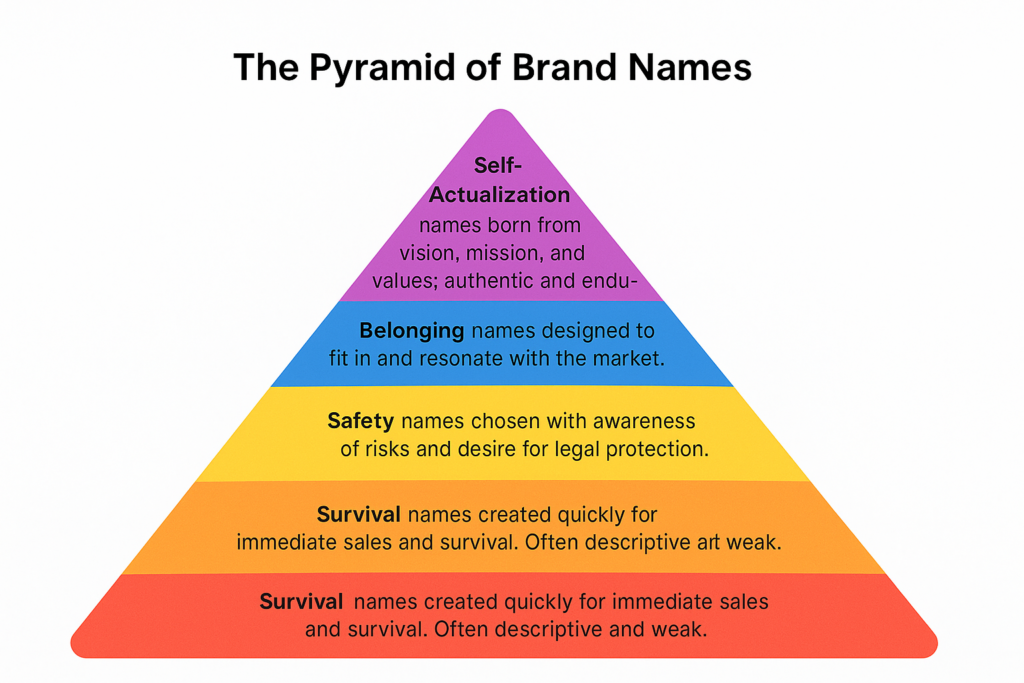
Too many businesses create names from the bottom levels—from fear, scarcity, and urgency. The strongest names are created from the top—from vision, mission, and authenticity. Still, the name must match all levels’ needs!
If I asked you, which level and which needs are matched by your brand and product names?
A trademark is the only type of intellectual property that can last indefinitely. This is why a name must reflect not just the present but the highest vision of the entrepreneur.
The difference between a registered and an unregistered trademark is fundamental.
A registered trademark:
An unregistered trademark:
Trademark registration fees are relatively small compared to the protection they provide. Registration typically lasts ten years and can be renewed indefinitely. It is one of the most secure and cost-effective protections for business.
The advantages of trademark registration are far-reaching:
Trademarks are not only legal instruments. They are business assets, marketing tools, and symbols of trust. They are the foundation of brand safety and long-term value.
This is why I always encourage entrepreneurs to treat their brand name as sacred. Check it carefully. Protect it early. Strengthen it continuously. Because a strong trademark is not only the shield of your brand—it is the fire that carries your business forward.
Master the art of brand naming and protection
Protect your brand from the start.
Your trademark is the one part of your brand that can last forever — legally and emotionally. Make it perfect from the start!
Explore our Done-for-You Trademark Search Services for personalized legal insight and support.
Start strong. Stay safe. Stand out.
No more guessing. No more risking. Your perfect trademark is just a click away. Whether you need a name, a search, or full legal protection — we’re here to make it easy, empowering, and aligned with your vision.
Improve or build your products with passion.
Invent the name your brand deserves.
Verify safety, avoid conflicts.
Own it legally, grow with confidence.

"*" indicates required fields